How to Vet Influencers for Authenticity: The Definitive 2026 Checklist for Brands

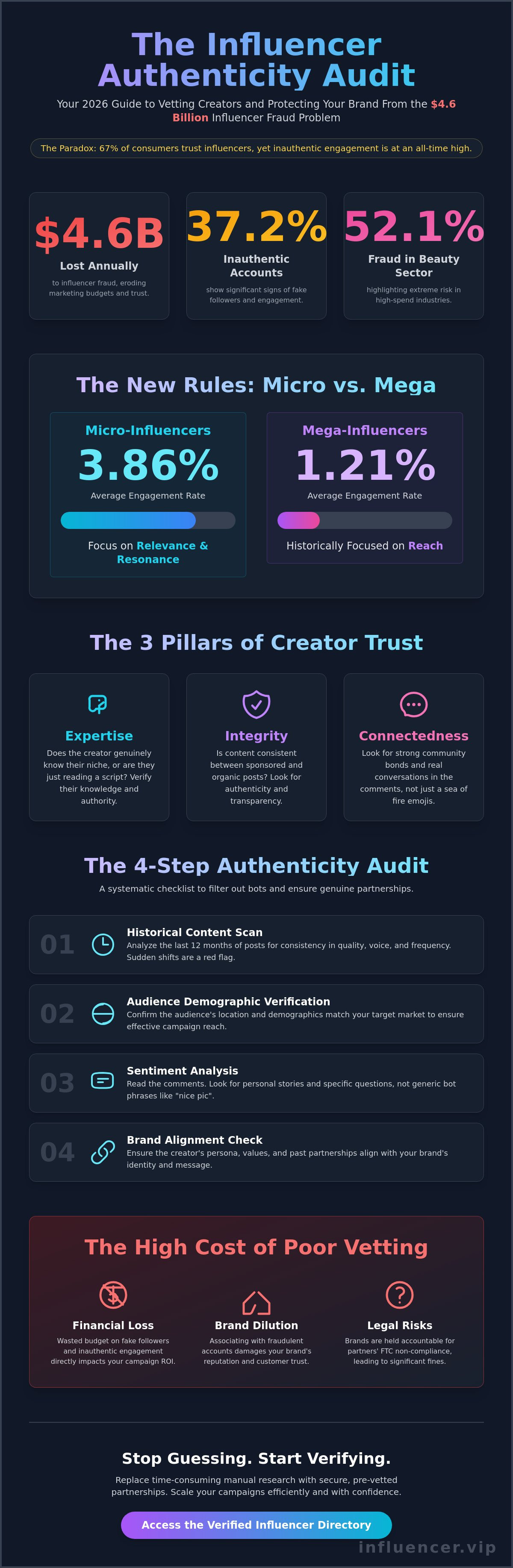
Brands are currently losing an estimated $4.6 billion annually to influencer fraud. With 37.2% of accounts showing signs of inauthentic engagement, the risk of wasting your marketing budget is at an all-time high. Learning how to vet influencers for authenticity is no longer a luxury; it's a critical business requirement for protecting your brand's reputation and capital.
You likely realize that a high follower count doesn't guarantee a return, especially when fraud rates in sectors like beauty have reached 52.1%. Relying on manual research is slow and often inaccurate. You need a streamlined, data-driven approach to verify that the creators you partner with actually reach real people who are ready to buy. This guide helps you master the art of influencer vetting with a definitive checklist designed for the 2026 market.
Gain the confidence to secure partnerships that deliver genuine engagement and measurable ROI. We'll examine behavioral consistency, first-party audience insights, and the latest FTC disclosure requirements to ensure your brand remains compliant and profitable.
Key Takeaways
Identify why traditional vetting fails in the $24 billion creator economy and how to protect your marketing spend from eroding trust.
Execute a 6-step audit that teaches you how to vet influencers for authenticity through historical content scans and demographic verification.
Calculate the True Engagement Rate to distinguish between manufactured vanity metrics and genuine audience sentiment that drives conversions.
Detect sophisticated AI-driven fraud and sudden follower surges using modern behavioral analysis techniques to safeguard your brand reputation.
Scale your campaigns efficiently by accessing a verified influencer directory to replace time-consuming manual research with secure, pre-vetted partnerships.
Table of Contents
The 2026 Authenticity Crisis: Why Traditional Vetting Isn't Enough
Partnering with Verified Creators: The Influencer.vip Solution
The 2026 Authenticity Crisis: Why Traditional Vetting Isn't Enough
Authenticity in the 2026 creator economy isn't a vague "vibe." It's a verifiable metric defined by behavioral consistency and transparent audience interaction. As the influencer marketing industry scales toward a projected $40.51 billion market size, a strange paradox has emerged. While 67% of consumers now trust influencers, the prevalence of sophisticated fraud makes finding genuine partners harder than ever. Brands can't rely on follower counts when nearly 37.2% of accounts show significant signs of inauthentic engagement.
To better understand how to identify these deceptive practices and protect your brand, watch this helpful video:
Modern marketing has shifted its focus from "Reach" to "Relevance" and "Resonance." A million followers mean nothing if they aren't the right followers. High-performing campaigns now prioritize micro-influencers, who boast engagement rates of 3.86%, significantly higher than the 1.21% seen with mega-influencers. Learning how to vet influencers for authenticity is the only way to ensure your message reaches a human audience instead of a bot farm.
The Five Dimensions of Creator Trust
Trust isn't built overnight. It's the result of several critical pillars that every brand must evaluate before signing a contract. Expertise is paramount; you must determine if the creator actually knows their niche or if they're just reading a script. Integrity involves checking for consistency between sponsored and organic content. If a creator promotes a luxury skincare line but uses budget brands in their "get ready with me" videos, their integrity is compromised. Finally, look for connectedness. This is the strength of the community bond found in the comments. Authentic creators foster real conversations, not just a sea of fire emojis.
The Cost of Poor Vetting
Failing to verify your partners leads to more than just a quiet campaign. It results in direct financial loss. With brands wasting $4.6 billion annually on fake followers, every unvetted dollar is a risk. You also face long-term brand dilution. Associating with inauthentic creators signals to your customers that you don't value quality or honesty.
Legal risks are also mounting. In markets like the UAE, regulatory scrutiny has intensified, and brands are held directly accountable for the actions of their partners. Violating disclosure rules or partnering with fraudulent accounts can lead to significant fines. Protect your investment by utilizing a Verified Influencer Directory to bypass the risks of manual research. Professional vetting ensures your budget drives real growth rather than padding the pockets of bot-driven scammers.
The 6-Step Authenticity Audit: A Comprehensive Checklist
Mastering how to vet influencers for authenticity requires a systematic approach that looks beyond the surface. You can't afford to guess when billions of dollars are lost annually to influencer fraud. Use this rigorous six-step audit to protect your brand and ensure every partnership is built on a foundation of genuine trust. This process moves from broad observations to granular data analysis, ensuring no bot-driven account slips through your filters.
Step 1: Historical Content Scan. Analyze the last 12 months of posts. Look for consistency in quality, voice, and frequency. Sudden shifts in content style often suggest a change in account ownership or a desperate attempt to pivot for sponsorships.
Step 2: Audience Demographic Verification. Confirm that the audience location matches your target market. If you sell products in the UAE but the creator's audience is 70% based in South America, your conversion rates will suffer.
Step 3: Sentiment Analysis. Read the comments carefully. Genuine engagement involves specific questions, personal stories, and nuanced reactions. Avoid creators whose sections are filled with generic bot phrases like "nice pic" or repetitive strings of emojis.
Step 4: Brand Alignment Check. Ensure the creator's personal values mirror your own. Their past content acts as a permanent record of their public persona. A mismatch here creates a significant PR risk that no amount of reach can justify.
Step 5: Transparency Review. Verify compliance with 2026 FTC guidelines. Disclosures like #ad or #partner must appear within the first three words of the caption. Failure to do so can result in fines of up to $43,792 per instance.
Phase 1: Surface-Level Verification
Start with the basics by checking for verified badges and a consistent cross-platform presence. A legitimate creator usually maintains a cohesive brand across Instagram, TikTok, and YouTube. Evaluate the ratio of sponsored versus organic posts. If a creator posts too many ads, their audience likely suffers from fatigue, leading to lower responsiveness. Confirm that their voice remains consistent across different media formats. A professional creator should sound the same in a podcast as they do in a short-form video.
Phase 2: Deep-Dive Data Analysis
Go deeper than the follower count. Use first-party data to confirm audience age and gender. Identify spikes in follower growth that don't align with viral content or major press coverage. These surges are almost always the result of bot purchases. Assess an 'Engagement Quality' score instead of a standard engagement rate. This metric focuses on high-value actions like saves and shares. These actions indicate that the content actually resonated with the viewer and prompted them to take an action. If you're overwhelmed by the manual work required, contact our experts to learn about our automated vetting tools.
Analyzing Engagement Quality and Audience Sentiment
High follower counts often mask a lack of real influence. To understand how to vet influencers for authenticity, you must look past vanity metrics like raw likes and follows. These numbers are easily manipulated through bot farms or engagement pods. Instead, prioritize value metrics such as saves and shares. These actions represent a conscious decision by a user to preserve or distribute content, signaling high resonance and potential for conversion. A post with 500 likes but 50 saves is often more valuable than one with 5,000 likes and zero saves.
Calculating the "True Engagement Rate" is a critical step in your verification process. Start by identifying the creator's total engagement over the last 30 days. You must then exclude interactions from suspicious accounts, such as those with no profile pictures or repetitive comment patterns. If a mega-influencer has an engagement rate significantly lower than the 1.21% industry average, their audience may be largely inactive. Conversely, if a micro-influencer's rate far exceeds the 3.86% benchmark without a viral catalyst, you should investigate for manufactured engagement.
The "Meaningful Comment" test offers a window into community depth. Genuine creators foster environments where followers feel compelled to share their own experiences. If the comment section is a repetitive stream of fire emojis or generic "great post" remarks, the community bond is likely weak. High-quality partnerships thrive when the audience is vocal, curious, and invested in the creator's recommendations.
The Anatomy of a High-Quality Comment
Identifying real human interaction requires a discerning eye. Look for these three markers of high-quality engagement:
Direct Questions: Followers asking for specific details about the product, price, or availability.
Personal Anecdotes: Users sharing their own stories or experiences related to the content topic.
Shared Values: Comments that echo the creator's sentiment or engage in a nuanced debate about the niche.
Audience Sentiment Mapping
Modern brands use AI-driven tools to categorize audience reactions as positive, neutral, or negative. This mapping helps identify "Ad Fatigue," where an audience becomes hostile or indifferent to sponsored content. If the sentiment drops every time a brand is mentioned, that creator is losing their persuasive power. Integrating these insights into your strategy is essential for Mastering Influencer Campaign Management. By focusing on sentiment rather than just volume, you ensure your brand enters a welcoming digital environment where your message can actually take root.
Red Flags and AI-Driven Fraud: Detecting Modern Scams
Detecting fraud in 2026 requires more than a quick glance at a profile. Scammers now use sophisticated AI to mimic human behavior, making it harder to distinguish real growth from manufactured stats. One of the most obvious red flags is a sudden follower surge. If an account gains 50,000 followers overnight without a viral post or major press mention, it's likely a bot purchase. You should also watch for high engagement from accounts with no profile pictures, no posts, and zero followers. These ghost accounts are the backbone of many fraudulent operations.
The rise of AI influencers adds a new layer of complexity to your vetting process. These synthetic creators can generate massive engagement, but they must be clearly disclosed to remain compliant. The FTC and YouTube now require creators to label AI-generated audio or video in both metadata and descriptions. When you learn how to vet influencers for authenticity, you must verify that these disclosures are present. Failing to disclose synthetic content doesn't just hurt trust; it exposes your brand to legal penalties of up to $43,792 per instance.
Spotting Engagement Pods
Creators often join engagement pods to trade likes and comments. This practice tricks platform algorithms into thinking a post is popular. You can detect this by looking for the same circle of users commenting on every single post. While this inflates metrics, it never leads to actual sales ROI. You're effectively marketing to a closed loop of other influencers rather than potential customers. This manufactured activity creates an illusion of influence that disappears the moment you stop paying for the partnership.
Brand Safety and Compliance
Authenticity also involves a creator's public history and legal standing. Check for past controversies or political statements that don't align with your brand values. Compliance is equally vital, especially in strictly regulated markets. For example, ensure your partners understand the requirements for Dubai filming permits to avoid legal delays or fines. Include strict moral clauses in your influencer contracts to protect your reputation if a creator's behavior shifts during the campaign.
Don't let sophisticated scams drain your marketing budget. Contact our experts today to secure your next campaign with verified, high-performing talent that delivers real results.
Partnering with Verified Creators: The Influencer.vip Solution
Manual vetting has become a massive operational hurdle for brands trying to scale. While understanding the mechanics of how to vet influencers for authenticity is essential, performing these checks manually for dozens of creators is an impossible task. In an era where bot-driven fraud costs billions, your marketing team's time is better spent on high-level strategy than on manual data auditing. Influencer.vip solves this bottleneck by providing a streamlined gateway to a curated ecosystem of pre-vetted talent.
Our platform shifts the focus from tedious verification to strategic growth. By providing a centralized directory, we enable brands to transition from transactional, one-off interactions to long-term niche influencer partnerships. These relationships are the foundation of high-ROI campaigns in 2026, as they build deeper trust with audiences over time. This shift allows you to move away from the "authenticity crisis" and toward a model of consistent, verifiable performance.
The Influencer.vip Vetting Standard
We uphold the industry's most rigorous benchmarks through our proprietary 10-point verification process. This system goes beyond vanity metrics to analyze the core of a creator's influence. We leverage data-driven insights to confirm audience authenticity, ensuring that every follower and comment is genuine. When you partner with verified influencers through our platform, you bypass the risks of ghost followers and engagement pods entirely. This commitment to quality control ensures your budget is always invested in real human resonance rather than manufactured statistics.
Scale Your Strategy with Confidence
Expanding your reach shouldn't mean increasing your risk. Our professional services and campaign management tools provide the infrastructure needed to execute global campaigns without the friction of manual research. Brands using our marketplace report reducing their time-to-hire by 70%, allowing for faster pivots and more agile marketing execution. We act as a credible intermediary, facilitating professional relationships that are secure, effective, and results-oriented.
Influencer.vip eliminates the risk of fake engagement in 2026 by providing a secure, transparent environment where only validated creators can connect with premium brands. Our streamlined approach ensures your brand remains ambitious, organized, and consistently ahead of the competition.
Master Authentic Influence and Drive Real ROI
The 2026 creator economy demands a shift from surface-level metrics to deep, data-driven validation. You've seen how a significant 37.2% of accounts now show signs of inauthentic engagement, making traditional vetting methods obsolete. Mastering how to vet influencers for authenticity ensures your budget supports real human connections rather than contributing to the $4.6 billion lost annually to influencer fraud.
Protect your brand's reputation and capital by choosing a streamlined path to success. Influencer.vip offers access to a global network of 100% verified influencers, backed by built-in fraud detection and advanced audience analytics. We are trusted by leading brands in the UAE and globally to deliver secure, high-performing partnerships that prioritize quality and effectiveness.
Stop guessing and start growing with confidence. Hire Verified Creators on Influencer.vip and transform your influencer strategy into a reliable engine for genuine engagement. Your next high-conversion campaign starts with talent you can actually trust.
Frequently Asked Questions
How can I tell if an influencer has fake followers?
Analyze the follower list for "ghost" profiles that lack profile pictures, posts, or bios. Sudden spikes in follower growth that don't align with a viral post or major press event are a major red flag. Use behavioral analysis tools to check if the follower-to-like ratio is consistent with 2026 industry standards.
What is a good engagement rate for an authentic influencer in 2026?
Target an engagement rate of at least 3.86% for micro-influencers and 1.21% for mega-influencers. Nano-influencers typically see higher rates between 4% and 8%. When you learn how to vet influencers for authenticity, you'll find that these benchmarks help distinguish real community resonance from bot-driven inflation.
Are engagement pods illegal or just unethical?
Engagement pods are primarily a violation of platform terms of service and are considered highly unethical. While not strictly illegal in most jurisdictions, using them to manufacture influence can lead to legal issues regarding deceptive advertising. Brands risk significant reputational damage and potential regulatory scrutiny for partnering with creators who use these tactics.
How do I vet an influencer for a specific niche like UAE luxury?
Verify that the creator's audience is actually located in the UAE and matches the high-net-worth demographic required for luxury. Analyze their content aesthetic to ensure it meets the sophisticated standards of the region. Use a verified directory to find creators with a documented history of successful high-end partnerships.
Can AI tools accurately detect influencer fraud?
AI-driven behavioral analysis tools are currently the most effective way to identify sophisticated fraud at scale. These systems detect anomalies in engagement patterns and follower growth that manual reviews often miss. They are essential for any brand that needs to know how to vet influencers for authenticity in a landscape of AI-generated bot accounts.
What should I do if I discover an influencer I already hired is inauthentic?
Terminate the partnership immediately and invoke the "moral clause" or performance misrepresentation terms in your contract. Document all evidence of fraud, such as bot-driven engagement or participation in pods. Review your internal vetting procedures to ensure future budget is only allocated to creators with verified human audiences.
How often should I re-vet long-term influencer partners?
Perform a comprehensive audit of your long-term partners every quarter. Audience demographics and engagement quality can shift quickly as a creator's content evolves. Regular re-vetting ensures your partners remain compliant with the latest 2026 FTC guidelines and continue to deliver a high ROI for your brand.
Is follower count still relevant for vetting in 2026?
Follower count is now a secondary metric used only to establish potential reach rather than actual influence. Marketers in 2026 prioritize "True Engagement" metrics like saves and shares over total follower numbers. A smaller, highly engaged audience is almost always more valuable than a massive, disconnected following.
Comments
Leave a Comment
No comments yet. Be the first to share your thoughts!
Related Posts
How to Find the Right Influencers for Your Brand in the UAE in 2026
Finding influencers in the UAE is easy. Finding the right influencers is not. Learn how to select creators based on audience, location, niche, engagement, authenticity, and campaign goals.

Influencer Marketplace vs Agency: Choosing the Right Solution in 2026
74% of marketers plan to increase their influencer marketing budgets in 2026, yet many are still losing up to 30% of that spend to opaque fees. When deciding between an influencer marketplace vs agency, the stakes are high. You’re likely tired of the exhausting manual search for creators and the con…

Real Estate Drone Videography Dubai: 2026 Guide & Best Drones for Luxury Listings
In the 2026 Dubai property market, a high-resolution drone video is no longer a luxury; it's the bare minimum for entry. You likely recognize that standing out in oversaturated districts like Dubai Marina or Palm Jumeirah requires more than just standard listings. The complexity of navigating drone…