Influencer Marketplace vs Agency: Choosing the Right Solution in 2026

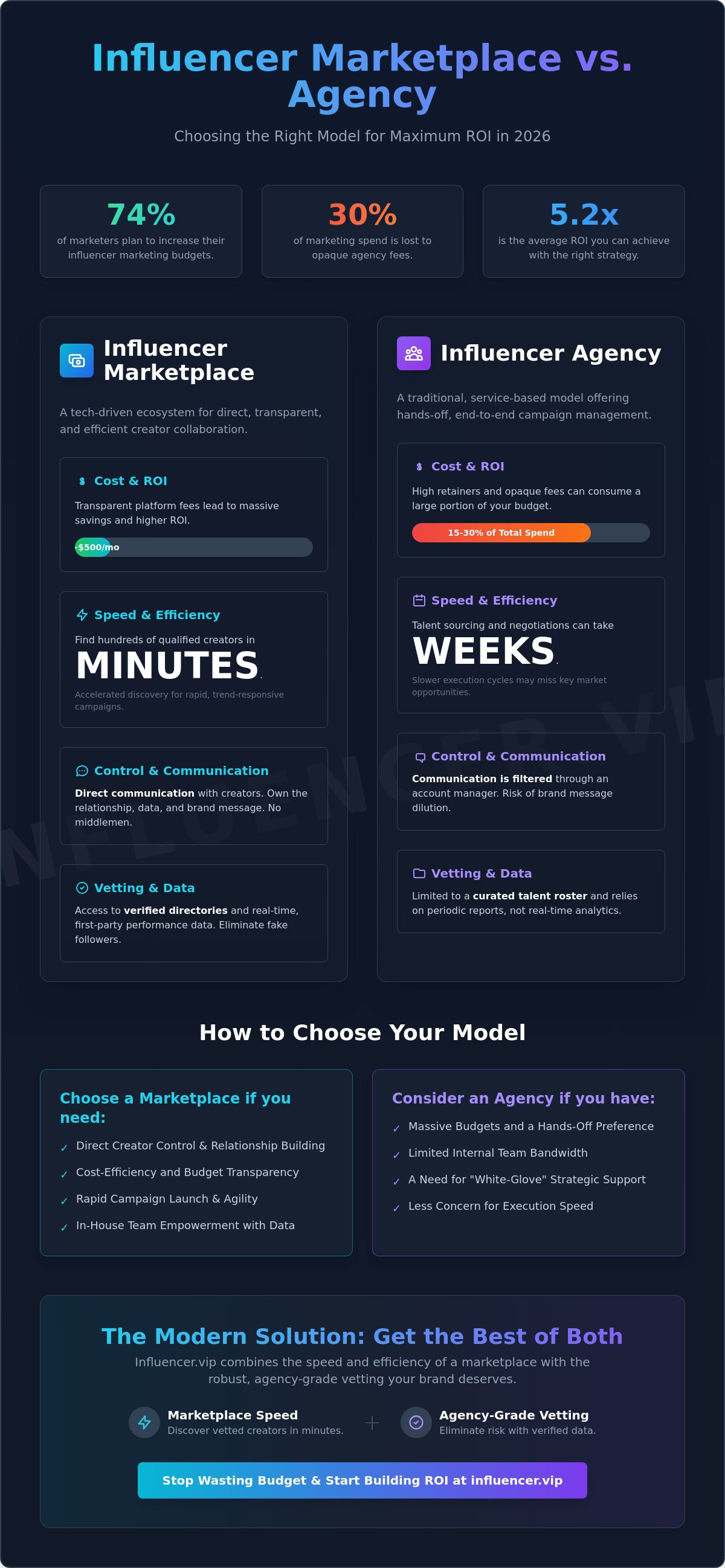
74% of marketers plan to increase their influencer marketing budgets in 2026, yet many are still losing up to 30% of that spend to opaque fees. When deciding between an influencer marketplace vs agency, the stakes are high. You’re likely tired of the exhausting manual search for creators and the constant risk of partnering with unverified accounts that hide behind fake followers.
We agree that your marketing team deserves a scalable strategy that prioritizes transparency and verified data. This guide will help you determine which solution maximizes your brand ROI and campaign efficiency. We’ll explore the critical differences in costs, vetting standards, and management tools to ensure you capture the 5.2x average return available in the current market.
Key Takeaways
Compare the influencer marketplace vs agency landscapes to decide between a tech-enabled ecosystem for direct collaboration or an end-to-end service model.
Maximize your campaign ROI by identifying the hidden costs of agency retainers and leveraging the cost-efficiency of direct creator partnerships.
Audit your internal team capacity and campaign scale to select a solution that aligns with your operational goals and long-term marketing strategy.
Secure your brand reputation by utilizing agency-grade vetting through a verified influencer directory to eliminate the risk of fake followers.
Accelerate your time-to-market by shifting from weeks of manual search to finding hundreds of qualified creators in minutes through automated discovery tools.
Table of Contents
Influencer Marketplace vs Agency: Navigating the 2026 Creator Landscape
The Marketplace Advantage: Efficiency, Data, and Direct Control
Evaluating the Agency Experience: Managed Services and Strategic Support
Influencer.vip: Combining Marketplace Speed with Agency-Grade Vetting
Influencer Marketplace vs Agency: Navigating the 2026 Creator Landscape
The strategic decision between an influencer marketplace vs agency has reached a boiling point in 2026. An influencer marketplace functions as a sophisticated, tech-driven ecosystem designed for direct creator collaboration. This model empowers brands to own their relationships and data. Conversely, an influencer agency remains a service-based model where dedicated experts handle end-to-end campaign logistics. As the industry moves toward a projected $52.1 billion valuation by 2030, it's clear the debate centers on whether you want to pay for external management or invest in internal capability.
Many organizations are shifting toward in-house operations to maintain tighter brand alignment and faster execution. To succeed, you must first master the basics of What is Influencer Marketing as it stands today. The current landscape prioritizes authenticity, with 71% of consumers trusting creators over traditional ads. This trust is easier to maintain when the brand speaks directly to the creator rather than through a third-party intermediary. It's a choice between complete control and total convenience.
To better understand how these different models impact your bottom line, watch this helpful analysis:
The Evolution of the Influencer Marketplace
Early marketplaces were little more than digital phone books. Today, they've transformed into full-stack collaboration hubs that integrate every step of the marketing funnel. High-end platforms now offer direct access to verified influencers, ensuring that every partner has been vetted for genuine engagement. Real-time data integration allows brands to see performance metrics as they happen, rather than waiting for a monthly report. This shift is critical as 84% of content is now video-based, requiring rapid feedback loops to optimize creative performance. By removing the "middleman," brands gain the agility needed to capitalize on viral trends within hours.
The Traditional Agency Model in a Digital-First World
Agencies continue to provide value through high-level strategic consulting and "white-glove" campaign execution. For brands with massive budgets and limited internal bandwidth, the hands-off nature of managed services is a significant advantage. However, the traditional model faces challenges in a digital-first economy. Agency rosters are frequently limited to specific talent pools, which may not offer the niche micro-influencer reach that currently delivers 3.2 times higher engagement. Additionally, the 15-30% fees charged by agencies are becoming harder to justify when compared to the $200 to $1,000 monthly costs of in-house platforms. While the strategic support is helpful, the communication lag and lack of direct control can hinder brands that need to be nimble.
The Marketplace Advantage: Efficiency, Data, and Direct Control
Speed defines success in the 2026 creator economy. When comparing an influencer marketplace vs agency, the most immediate differentiator is velocity. A traditional agency often requires weeks to vet, contact, and present a curated list of talent. In contrast, a modern marketplace allows you to identify 100+ qualified creators in minutes. This agility is essential for brands that need to move at the speed of social trends rather than waiting on account manager emails.
Owning the creator relationship directly fosters long-term loyalty that an intermediary cannot replicate. When you communicate without a middleman, you build genuine partnerships. These direct lines of communication ensure that brand values aren't lost in translation. It also makes it easier to verify that all posts adhere to FTC disclosure guidelines. This level of oversight is vital for maintaining brand safety and legal compliance across every campaign.
Accelerated Discovery and Real-Time Analytics
Modern platforms use advanced filters to pinpoint niche talent across specific global markets, such as the UAE or Europe. You can access first-party data directly from creator profiles instead of relying on outdated media kits. This transparency allows you to see exactly who follows a creator and how they interact with content. Marketplace analytics provide granular audience insights that instantly flag suspicious activity, ensuring you never waste budget on bot-driven engagement. This data-first approach replaces guesswork with verified performance metrics.
Cost-Effectiveness and Budget Transparency
The financial logic of the marketplace model is compelling. Agencies typically charge 15-30% of your total campaign spend as a management fee. For a high-growth brand, this overhead scales aggressively. Marketplace platforms usually operate on a subscription basis, with costs ranging from $200 to $1,000 per month according to verified industry data. This predictable pricing allows you to reallocate funds toward actual creator fees or high-quality production. The suite of Influencer.vip services streamlines this transition by providing the tools needed for self-managed success without the agency markup.
Transparency extends beyond the platform fee. When you manage campaigns in-house, you see exactly what each creator is paid. There are no hidden margins or bundled costs that obscure your actual ROI. If you're ready to take full control of your creator strategy and maximize your efficiency, speak with our specialists to explore our directory of verified talent.
Evaluating the Agency Experience: Managed Services and Strategic Support
Agencies offer a sense of security for large-scale, multi-channel launches that require complex coordination. If your 2026 marketing plan involves a global product rollout across five different social platforms simultaneously, the "white-glove" service of an agency can be tempting. They act as an extension of your team, handling the heavy lifting of contract negotiations and creative briefs. However, this convenience comes with specific operational risks that the influencer marketplace vs agency debate often overlooks. You must decide if the convenience of outsourcing outweighs the loss of direct oversight.
Roster bias is a significant risk in the traditional agency model. Many agencies prioritize creators they already represent or have signed to exclusive contracts. This practice limits your brand to a narrow pool of talent that may not be the best fit for your specific audience. While agencies manage local logistics, such as securing Dubai filming permits for high-end video shoots, this expertise is no longer exclusive to them. Modern marketplaces now provide the tools and verified directories to manage these same logistics with greater transparency and significantly lower overhead.
The High Cost of Outsourced Management
Breaking down the costs reveals a substantial gap in efficiency. Agency fees in 2026 typically range from 15% to 30% of the total campaign spend. Some firms also require monthly retainers that can drain your budget before a single post goes live. Beyond the financial cost, there's a significant "communication lag." Messages pass through multiple layers of account managers, which slows down execution in a market that demands real-time responses. High turnover within agency teams can also disrupt your campaign consistency, leaving your brand strategy in the hands of someone who wasn't there for the kickoff.
Creative Direction vs. Brand Authenticity
Authenticity drives results in the modern digital landscape. There's a growing trade-off between polished, agency-led content and the raw style of User-Generated Content (UGC). Agencies often over-produce content, making it look like a traditional commercial that viewers instinctively skip. In 2026, consumers crave genuineness; they want to see creators using products in real-life settings. Direct communication through a marketplace preserves your brand voice because you speak to the creator yourself. This eliminates the "telephone game" where your original vision gets diluted by agency intermediaries. Today's consumers prefer direct brand-to-creator collaborations because these partnerships feel more transparent and less like a forced advertisement.
A Decision Framework: How to Choose Your Model
Selecting the right path between an influencer marketplace vs agency requires a cold, hard look at your internal resources and long-term growth targets. This isn't just about current budget; it's about where you want your brand to stand in the $32.6 billion influencer economy of 2026. To make an informed choice, follow this four-step framework to determine which model secures the highest ROI for your specific situation.
Step 1: Audit your internal team capacity. Determine if you have the daily bandwidth to manage creator communications or if you need to outsource the entire workflow.
Step 2: Define your campaign scale. Decide if you're executing a one-off product launch or building an always-on creator program that requires hundreds of micro-influencer partnerships.
Step 3: Evaluate your need for creative control. Assess whether you want direct input on content or if you prefer a managed execution model where an external team handles the creative brief.
Step 4: Compare long-term ROI potential. Analyze the 5.2x average return on investment and decide if paying a 30% agency fee aligns with your profit margins.
Assessing Your In-House Capabilities
Success in a marketplace model depends on your team's ability to execute. Ask yourself: does your marketing department have the time for rigorous outreach and vetting for authenticity? In 2026, the risk of fake followers is managed through advanced tech, but you still need a human touch to ensure brand alignment. You'll need a suite of campaign management tools to track deliverables and performance metrics in real-time. If your team is already stretched thin, start with a managed approach and transition to a marketplace once your internal processes are streamlined for scaling.
Matching Campaign Goals to the Right Solution
Your specific goals should dictate your infrastructure. Marketplaces excel at high-volume, performance-driven campaigns that rely on authentic User-Generated Content (UGC). This is particularly effective in fast-growing markets like the UAE, where digital-first consumers demand high-frequency, relatable content. Agencies, however, might still hold value for high-stakes, celebrity-level ambassadorships where legal complexity is the primary concern. For most modern brands, a hybrid approach works best. You can leverage Influencer.vip services to access a verified directory while maintaining the direct control required for maximum brand impact.
The choice between an influencer marketplace vs agency ultimately comes down to whether you view influencer marketing as an outsourced expense or a core business capability. If you're ready to build a scalable, data-backed creator strategy that you own entirely, contact our team today to explore our verified influencer directory.
Influencer.vip: Combining Marketplace Speed with Agency-Grade Vetting
Choosing between an influencer marketplace vs agency often feels like a compromise. You either sacrifice speed for the vetting of an agency or sacrifice quality for the uncurated volume of a standard marketplace. Influencer.vip removes this friction by acting as a bridge between the two models. It delivers the rapid execution of a digital platform alongside the rigorous verification standards typically reserved for high-end agencies. This hybrid approach ensures your brand scales without compromising on creator authenticity or campaign safety.
Our ecosystem is built for the global stage with a specialized focus on high-growth regions like the UAE and Dubai. We provide integrated tools that extend far beyond simple discovery. Brands can access professional drone shooting, photography, and videography services directly through our platform. This eliminates the need to hire multiple external vendors for a single campaign. By consolidating your creator search and production needs into one streamlined workflow, you reduce management overhead and maintain a consistent visual identity across all social channels.
Why Verified Creators Outperform General Databases
Most marketplaces are plagued by search fatigue because they prioritize quantity over quality. Our Verified Creator status is a primary differentiator. We vet every influencer for genuine engagement and audience quality, effectively eliminating the risk of bot-driven metrics. This rigorous process mirrors agency-level scrutiny but functions at marketplace scale. For a deeper look at local market standards, consult our best influencer marketing platforms in Dubai guide. It serves as a benchmark for brands that demand high-performance partnerships in competitive sectors.
Scaling Global Campaigns with a Streamlined Ecosystem
Expanding your brand into new international markets shouldn't require a fragmented tech stack. Influencer.vip facilitates global growth from a single, intuitive dashboard. You can manage multi-market campaigns, track real-time analytics, and coordinate with creators across different time zones simultaneously. Our platform is designed to support the 84% of content that is now video-based by integrating professional production services into your influencer workflow. This ensures that every piece of content meets your brand's high standards before it goes live.
Access a directory of vetted talent with proven engagement histories.
Utilize integrated campaign management tools to track ROI in real-time.
Leverage professional photography and drone services for premium content production.
Scale your brand presence across the UAE and beyond with localized expertise.
The 2026 creator economy moves too fast for traditional agency lag, but it's too competitive for unvetted marketplace data. If you're ready to secure a results-oriented partnership that combines the best of both worlds, take the next step. Join the marketplace as a brand today and start building a verified, scalable influencer strategy that delivers clear ROI.
Master Your Creator Strategy for 2026 and Beyond
The choice between an influencer marketplace vs agency defines your brand's agility in an increasingly competitive digital landscape. You've seen how shifting toward a marketplace model eliminates the 15% to 30% fees typically associated with traditional agencies while providing direct access to authentic creator relationships. By prioritizing transparency and data-driven discovery, your team can finally move at the speed of social trends. It's about trading communication lag for immediate, verified results.
Ready to secure your place in the future of marketing? Access our directory of 10,000+ Verified Creators and leverage integrated campaign management tools with zero agency markups to maximize your efficiency. We're here to help you build a strategy that delivers measurable impact and lasting brand loyalty. Every partnership you forge should be rooted in quality and genuine engagement.
Start Scaling Your Brand with Verified Creators on Influencer.vip. From our headquarters in Dubai, we're empowering brands to achieve global excellence through streamlined, high-end creator partnerships.
Frequently Asked Questions
What is the main difference between an influencer marketplace and an agency?
Marketplaces are tech-driven platforms for direct collaboration, whereas agencies are managed service providers that handle campaigns on your behalf. This distinction is central to the influencer marketplace vs agency choice. Marketplaces prioritize brand control and data transparency, while agencies focus on hands-off convenience. Choose a marketplace to own your creator relationships or an agency to outsource the entire operational process.
Is an influencer marketplace cheaper than an agency?
Marketplaces are generally more cost-effective because they replace high agency commissions with predictable subscription fees. By removing the 15% to 30% management markup, you can allocate a larger portion of your budget directly to creators. This model significantly reduces overhead costs for high-volume campaigns and allows for better budget transparency. You'll see exactly where every dollar goes without hidden fees or bundled costs.
Can I use a marketplace if I have a small marketing team?
Yes, marketplaces are designed to empower small teams through automation and centralized management tools. Integrated features like automated outreach and performance tracking allow a single marketer to manage dozens of relationships efficiently. This technology bridges the gap for lean organizations that need to scale without hiring an external agency. Use these tools to automate repetitive tasks and focus on your broader creative strategy.
How do influencer marketplaces verify the authenticity of creators?
Leading platforms use advanced AI and first-party data integration to analyze audience quality and engagement authenticity. They flag suspicious patterns, such as sudden follower spikes or bot-like comment activity, to protect your brand reputation. This ensures you only partner with creators who have genuine, verified influence. This data-driven vetting process is essential for maintaining high standards in a market where 71% of consumers trust creator content.
Which model is better for running UGC campaigns in 2026?
The marketplace model is superior for User-Generated Content (UGC) because it facilitates high-volume, direct collaborations at a lower cost. In 2026, 84% of content is video-based, requiring a large volume of raw, authentic assets. A marketplace allows you to source hundreds of UGC pieces without the creative dilution often found in agency-managed content. This direct approach preserves your brand voice while maximizing your total content output.
Should I switch from an agency to a marketplace to improve my ROI?
Switching to a marketplace can improve ROI by lowering management fees and providing direct access to performance data. Brands that manage campaigns in-house often see better alignment with their core goals. This transition is a strategic move for companies looking to maximize the 5.2x average return on investment reported in 2026. The influencer marketplace vs agency decision should prioritize long-term profitability and data ownership for your brand.
How do I manage multiple influencer campaigns on a marketplace platform?
Use integrated campaign management tools to track deliverables, deadlines, and payments across various creator groups. These dashboards provide a unified view of all active programs, making it simple to monitor progress without messy spreadsheets. Streamlined workflows ensure that even complex, multi-market initiatives remain organized and on schedule. Leverage these tools to maintain clear communication and ensure every creator meets their specific campaign milestones.
What are the risks of using an unvetted influencer marketplace?
Unvetted marketplaces carry significant risks of fraud, fake engagement, and non-compliance with FTC regulations. Partnering with unverified creators can damage your brand reputation and result in wasted marketing spend. Always prioritize platforms that offer a verified influencer directory to ensure your partnerships are secure and effective. High-quality vetting is the only way to avoid the risk of partnering with creators who hide behind fake followers.
Comments
Leave a Comment
No comments yet. Be the first to share your thoughts!
Related Posts
How to Find the Right Influencers for Your Brand in the UAE in 2026
Finding influencers in the UAE is easy. Finding the right influencers is not. Learn how to select creators based on audience, location, niche, engagement, authenticity, and campaign goals.

Real Estate Drone Videography Dubai: 2026 Guide & Best Drones for Luxury Listings
In the 2026 Dubai property market, a high-resolution drone video is no longer a luxury; it's the bare minimum for entry. You likely recognize that standing out in oversaturated districts like Dubai Marina or Palm Jumeirah requires more than just standard listings. The complexity of navigating drone…

How to Analyze an Influencer Media Kit: The 2026 Strategic Audit Guide
On average, influencer marketing returns $5.78 for every $1 spent, but that return vanishes if you cannot distinguish between authentic influence and inflated numbers. You have likely experienced the frustration of reviewing a glossy PDF and wondering if those followers will actually convert into cu…