What are Influencers? The Comprehensive 2026 Guide to Modern Influence

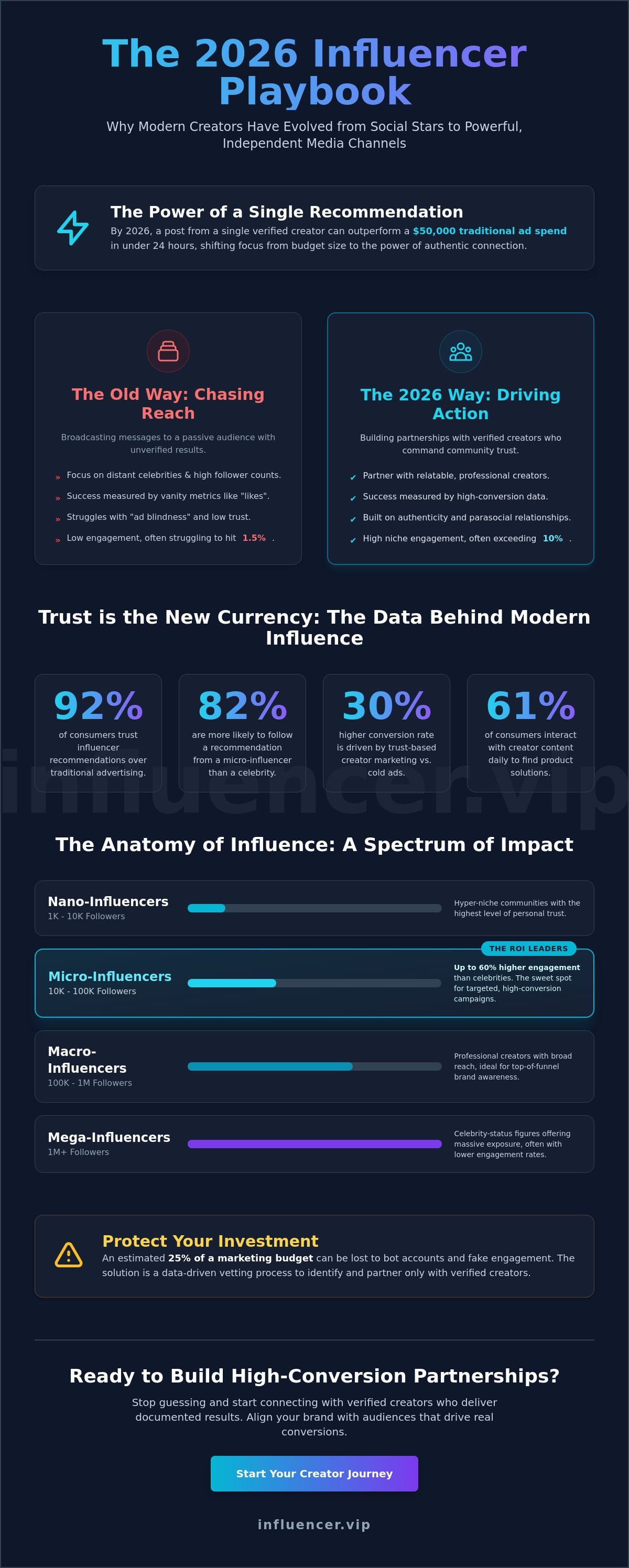
By 2026, a single recommendation from a verified creator can outperform a $50,000 traditional ad spend in under 24 hours. The reality is that influencers have transitioned from social media personalities into sophisticated, independent media channels that drive the global economy. You likely feel the frustration of distinguishing between a high-reach celebrity and a high-conversion creator. It's stressful to worry that 25% of your marketing budget might disappear into a pool of bot accounts without a clear way to measure your return on investment.
This guide promises to clear that confusion and show you why these digital partners are the cornerstone of brand growth in 2026. We will analyze the four essential tiers of modern creators, share a 5-point framework for auditing authenticity, and provide the exact steps to initiate your first high-conversion campaign. You'll gain the confidence to stop guessing and start building partnerships that deliver documented results for your business. It's time to move beyond simple likes and focus on the metrics that actually scale your brand.
Key Takeaways
Understand how the industry has shifted from social stars to professional decentralized media channels essential for the 2026 economy.
Learn why micro-influencers deliver superior ROI for targeted UAE campaigns and how to select the right tier for your specific brand goals.
Discover why modern influencers outperform traditional advertising by overcoming ad blindness and delivering higher engagement at a lower CPM.
Master the data-driven vetting process to identify verified creators and ensure your campaign budget is protected from fake engagement.
Define a clear roadmap for your creator journey by aligning your marketing objectives with the audiences that drive real conversions.
Table of Contents
What are Influencers? Redefining Influence for the 2026 Economy
Strategic Value: Why Influencers Outperform Traditional Advertising
What are Influencers? Redefining Influence for the 2026 Economy
In the 2026 economy, influencers function as decentralized media channels. They represent a fundamental shift from the broad, broadcast style of the past to a more targeted, community-driven approach. While the 2010s focused on social stars who gained fame through viral trends, the current landscape belongs to professional content creators. These individuals maintain dedicated, loyal audiences by providing consistent value. To understand the foundational concept, you might ask, What is an influencer? at its core. It's no longer about a simple follower count. In 2026, 82% of consumers report they're more likely to follow a recommendation from a micro-influencer than a traditional celebrity. Impact on behavior is the primary metric for success. High-performing campaigns now prioritize conversion data over vanity metrics.
To better understand this concept, watch this helpful video:
The Shift from Celebrity to Creator
Traditional celebrities often feel distant and unattainable. Modern influencers build their platforms on relatability and direct engagement. This shift has fueled the rise of Expert Influencers in B2B sectors. By 2025, data showed that 75% of B2B buyers used social media to support purchase decisions. These specialists offer deep industry knowledge rather than just lifestyle content. Influence is the ability to bridge the gap between brand and consumer.
Why Influence is Built on Trust, Not Just Reach
Social proof remains the most powerful driver in the 2026 buying journey. As AI-generated noise floods digital spaces, influencers act as a vital human filter for information. They provide a perspective that algorithms can't replicate. Working with verified creators ensures brand safety and authentic connection. This creates a psychological pillar known as a parasocial relationship. In this dynamic, the audience feels a personal bond with the creator, leading to high levels of perceived reliability.
92% of users trust earned media and influencer recommendations over traditional advertising.
Engagement rates on niche platforms frequently exceed 10%, while legacy networks often struggle to hit 1.5%.
Trust-based marketing drives a 30% higher conversion rate compared to cold digital ads.
61% of consumers interact with creator content daily to find product solutions.
Brands that prioritize these deep connections see better long-term results. The focus has moved from "how many see this" to "who takes action." Efficiency in 2026 means finding the right voice for the right audience. This results-oriented approach ensures that every marketing dollar contributes to measurable growth.
The Anatomy of Influence: Tiers, Types, and Categories
Influence isn't a monolith. It's a spectrum defined by the delicate balance between reach and resonance. To build a successful strategy, you must first categorize influencers based on their audience size and the specific role they play in the marketing funnel. Modern industry standards divide these creators into four primary tiers: Nano (1,000 to 10,000 followers), Micro (10,000 to 100,000 followers), Macro (100,000 to 1 million followers), and Mega (over 1 million followers).
In the UAE market, Micro-influencers have emerged as the ROI leaders. Data from 2024 shows that Micro-influencers often generate up to 60% higher engagement rates compared to their celebrity counterparts. They bridge the gap between personal recommendations and professional content creation. For a brand launching a SaaS product or a luxury real estate development in Dubai, a Micro-influencer with a verified, localized following provides a level of trust that mass-market advertising can't replicate. Transparency remains the foundation of this trust; adhering to FTC guidelines for influencers ensures that every partnership is clearly disclosed, protecting both the brand's reputation and the creator's credibility.
The definition of influence also shifts depending on the platform's architecture. On LinkedIn, influence is measured by professional authority and B2B thought leadership. On TikTok, it's defined by creative agility and the ability to spark trends. YouTube remains the home of long-form "Edutainment," where influencers act as educators who simplify complex topics for a global audience.
Reach vs. Resonance: Choosing the Right Tier
Nano-influencers offer the highest levels of community trust. Their followers are often friends, family, or local peers, leading to an average engagement rate of 7% or higher. Conversely, Mega-influencers provide the prestige and mass awareness required for global product launches. Choosing between them depends on your specific goals. For deeper insights into industry-specific performance, refer to our Niche Influencers in the UAE guide to see how different tiers perform across sectors like fashion and tech.
Categorization by Content Format
Content format is now as important as follower count. User-Generated Content (UGC) creators focus on producing high-quality assets for brands to use in their own ads, often without needing a large personal following. Meanwhile, the demand for cinematic quality is rising. High-end creators in the Middle East are increasingly integrating drone videography marketing to provide breathtaking perspectives on hospitality and real estate projects. This shift toward high-production value separates top-tier professionals from casual posters.
If you're ready to identify which tier of creator aligns with your brand's specific goals, you can connect with our specialists to build a data-backed campaign.
Strategic Value: Why Influencers Outperform Traditional Advertising
Traditional display ads face a steep decline in effectiveness. Research shows the average click-through rate for banner ads has plummeted to 0.06%, a phenomenon known as ad blindness. Consumers have trained themselves to ignore the periphery of websites and skip commercial breaks. Influencers bypass this barrier by integrating brand messages directly into the content flow. Instead of an interruption, the promotion becomes a valued part of a trusted narrative.
Influencer campaigns often provide superior CPM (Cost Per Mille) metrics compared to legacy media. While a 30-second TV spot during prime-time can cost over $30 per thousand viewers with broad targeting, influencers deliver a surgical approach. You pay for access to a specific, engaged niche rather than a diluted mass audience. This efficiency enables an 'Always-On' strategy. Brands don't have to rely on sporadic, expensive bursts. They can maintain a continuous presence through a steady stream of creator content that keeps the brand top-of-mind year-round.
The benefits extend into technical search authority. When influencers mention your brand or link to your site, it generates social signals and high-quality referral traffic. These mentions drive search engine visibility, helping your brand climb the rankings through authentic digital footprints rather than manufactured backlinks.
Higher Engagement: Stories and reels generate active participation compared to static billboards.
Precise Targeting: Reach specific demographics based on interests, location, and behavior.
Content Longevity: Social posts remain searchable and discoverable long after a campaign ends.
Influencers as Trust-as-a-Service Providers
Data from Nielsen indicates that 92% of consumers trust recommendations from individuals over traditional brand advertisements. This preference stems from a demand for authenticity. A raw, unscripted review captured on a smartphone often converts better than a polished studio production because it feels real. In specialized markets, this trust is built on deep cultural alignment. For instance, influencer marketing in Dubai thrives because local creators understand regional nuances and the specific luxury expectations of the Middle Eastern market.
Beyond Awareness: Driving Conversions and Loyalty
Modern collaborations focus on measurable results. By using trackable discount codes and unique affiliate links, brands transform social engagement into direct-response marketing. This allows for real-time optimization of your marketing spend. Long-term partnerships build deeper brand affinity than one-off ads, turning influencers into genuine brand ambassadors. In B2B sectors, influencers shorten the sales cycle by providing the expert validation needed to move prospects through complex procurement stages faster. This creates a streamlined path from initial discovery to a closed contract.
Common Misconceptions and the Reality of 2026 Influence
The perception of influencers has shifted from casual hobbyists to high-level digital entrepreneurs. In 2026, the "selfie myth" is officially dead. Top-tier creators now operate like boutique media houses. A single 60-second vertical video often requires 10 to 15 hours of editing, color grading, and script refinement. Statistics show that 72% of professional creators now utilize cinema-grade equipment and dedicated creative teams to meet the rising standards of brand partnerships. This isn't amateur hour; it's a sophisticated production industry.
Demographics have also evolved beyond the stereotypical Gen Z audience. LinkedIn reported a 45% surge in engagement for professional thought leaders throughout 2025. The 40+ age bracket currently represents the fastest-growing consumer segment on visual platforms, bringing significantly higher disposable income than younger cohorts. Brands targeting luxury, real estate, or B2B services find their most effective partners in these mature, niche spaces.
Ethics and transparency have moved from "best practices" to legal mandates. In the UAE, the National Media Council (NMC) regulations require influencers to maintain specific licenses and provide clear, unambiguous disclosure for all paid content. Failure to comply results in heavy fines or account suspension. This regulatory environment has created a safer, more professional marketplace for everyone involved.
Vanity Metrics vs. Actual Engagement
A high follower count no longer guarantees a successful campaign. In fact, a massive following can be a red flag if the engagement rate doesn't scale proportionally. Modern marketers prioritize sentiment analysis, which uses AI to determine if comments are genuine expressions of interest or merely bot-generated noise. Understanding these nuances is critical for ROI. Brands are discovering that mastering influencer campaign management is the most effective way to filter out accounts with inflated numbers and focus on those that drive real conversions.
The Vetting Revolution: Finding Authentic Partners
Manual vetting is no longer sufficient in an era where AI can simulate realistic follower growth and engagement patterns. The industry has pivoted toward "Verified Creators" to maintain brand safety. This shift involves deep-dive data audits that verify audience location, age, and authenticity. Platforms like Influencer.vip provide this essential layer of quality assurance, vetting every creator to ensure they meet strict professional standards. This data-driven approach reduces the risk of fraudulent partnerships by 60% compared to traditional manual selection methods.
Ready to build a campaign backed by data and verified talent? Contact our team to get started today.
Navigating the Creator Economy: How to Start Your Journey
Success begins with a clear objective. Brands typically prioritize one of three metrics: brand awareness, engagement, or direct conversions. In the UAE market, where 99% of the population is active on social media as of 2024, narrowing your focus is essential. You need to identify which influencers your specific customers actually trust. Don't just look at follower counts. Analyze whether their content resonates with the local demographic in Dubai, Abu Dhabi, or Riyadh. A targeted approach often yields a 30% higher engagement rate than broad, unoptimized campaigns.
Setting a realistic budget is the next step. Influencer rates in the Middle East vary based on niche, platform, and historical performance. Instead of manual outreach, use a centralized system to manage your spend. Leveraging a marketplace streamlines discovery and ensures contract management is secure. This reduces the time spent on administrative tasks by up to 60%. It also protects your investment through verified agreements and clear payment terms, which is vital for maintaining professional standards.
Finding the Right Fit for Your Brand
Brand alignment is more than just a shared aesthetic; it's about values. Does the creator's lifestyle genuinely reflect your brand's mission? You shouldn't guess. Use data to verify their geographic reach and audience authenticity. A creator might have a million followers, but if only 10% are in your target region, your ROI will suffer. You can use the Influencer Marketplace to access discovery tools and filter by verified demographics. This ensures you're partnering with influencers who have a proven track record in your specific industry. Focus on these key metrics:
Audience location and language.
Historical engagement rates per post.
Comment-to-like ratios to detect bot activity.
Previous brand collaboration success stories.
Executing Your First Campaign
Your first campaign relies on a professional brief. Give creators enough freedom to keep their voice authentic while setting clear expectations for deliverables. Data shows that 77% of creators prefer brands that offer creative flexibility. A rigid script often leads to content that feels forced and fails to convert. Monitor results in real-time to optimize performance. If one content format is driving more clicks, shift your focus there immediately to maximize your budget. Ready to amplify your brand? Find & Hire Top Influencers on Influencer.vip.
Mastering the 2026 Influence Landscape
The marketing world has shifted toward a creator-first economy where trust is the primary currency. Success in 2026 requires moving beyond vanity metrics to embrace strategic partnerships that drive real conversions. You've learned that influencers are no longer just social media personalities; they're essential business partners who outperform traditional advertising through verified engagement and niche authority. By understanding the different tiers of influence, you can build a roadmap that scales with your brand's ambitions.
Don't leave your growth to chance in a competitive market. Our platform provides immediate access to a global network of verified creators. Data shows that 92% of businesses found the right partner through our marketplace. We've delivered proven results across the UAE and Dubai markets, helping brands turn digital presence into measurable ROI. It's time to stop guessing and start growing with a system designed for the modern economy.
Ready to lead your industry? Elevate your brand with verified UAE influencers today. The future of your brand starts with the right connection.
Frequently Asked Questions
What is the difference between an influencer and a celebrity?
A celebrity gains fame through traditional media like films or sports, while influencers build authority through social media content and niche communities. Celebrities offer broad reach, but these digital creators often achieve 60% higher engagement rates because their audience views them as relatable peers. This shift makes them more effective for driving specific consumer actions rather than just general awareness.
How much do influencers charge for a post in 2026?
Pricing in 2026 follows a tiered structure based on follower count and verified engagement rates. Nano-influencers typically charge $10 to $100 per post, while mega-influencers with over 1 million followers often command $10,000 or more per collaboration. These rates vary by platform, with video content on TikTok or YouTube often costing 25% more than static image posts due to higher production demands.
Are micro-influencers better than macro-influencers for small businesses?
Micro-influencers are generally more effective for small businesses due to their 7% average engagement rate compared to the 1.5% typically seen with macro-influencers. They offer a cost-effective way to target specific niches without the high price tag of major stars. Research shows that 82% of consumers are likely to follow a recommendation from a micro-influencer, making them a high-conversion choice for limited budgets.
How do I know if an influencer has fake followers?
You can identify fake followers by analyzing the engagement-to-follower ratio and checking for sudden, inorganic spikes in follower growth. If an account has 100,000 followers but only receives 10 likes per post, it's a red flag. Use auditing tools to verify that comments are meaningful rather than generic emojis or repetitive phrases from bot accounts. Authentic creators maintain steady growth patterns over time.
What are the legal requirements for influencer marketing in the UAE?
Influencers in the UAE must obtain a formal license from the Media Council to conduct commercial activities and paid promotions. All partnerships require a clear disclosure like "#ad" or "Paid Partnership" to comply with 2024 transparency regulations. Failure to hold a valid permit can result in fines starting at 5,000 AED for both the brand and the creator. It's a mandatory step for legal operations.
Can B2B companies benefit from influencer marketing?
B2B companies benefit significantly by partnering with industry thought leaders on platforms like LinkedIn to build professional trust. According to 2025 industry reports, 73% of B2B marketers state that these collaborations improved their brand credibility. This approach shifts the focus from broad awareness to targeted lead generation within specific sectors. It's an efficient way to reach decision-makers through voices they already respect.
What is a verified influencer and why does it matter?
A verified influencer is a creator whose identity and performance metrics have been authenticated by a platform like Influencer.vip to protect brands from fake influencers. This status matters because it guarantees you're working with real talent rather than fraudulent accounts. Verification reduces the risk of fraud, which cost global brands an estimated $1.3 billion in 2023. It ensures your marketing budget reaches genuine humans.
How do I track the ROI of an influencer campaign?
Track your ROI by using unique promo codes, UTM tracking links, and dedicated landing pages for every creator you hire. These tools allow you to measure direct sales, click-through rates, and customer acquisition costs with precision. By 2026, 90% of successful brands use real-time dashboards to compare performance against their initial KPIs. This data-driven approach removes the guesswork from your marketing spend.
Comments
Leave a Comment
No comments yet. Be the first to share your thoughts!
Related Posts
How to Find the Right Influencers for Your Brand in the UAE in 2026
Finding influencers in the UAE is easy. Finding the right influencers is not. Learn how to select creators based on audience, location, niche, engagement, authenticity, and campaign goals.

Influencer Marketplace vs Agency: Choosing the Right Solution in 2026
74% of marketers plan to increase their influencer marketing budgets in 2026, yet many are still losing up to 30% of that spend to opaque fees. When deciding between an influencer marketplace vs agency, the stakes are high. You’re likely tired of the exhausting manual search for creators and the con…

Real Estate Drone Videography Dubai: 2026 Guide & Best Drones for Luxury Listings
In the 2026 Dubai property market, a high-resolution drone video is no longer a luxury; it's the bare minimum for entry. You likely recognize that standing out in oversaturated districts like Dubai Marina or Palm Jumeirah requires more than just standard listings. The complexity of navigating drone…