The Ultimate Guide to Influencer Marketing in 2026: Strategy, Vetting, and ROI

Would you gamble $51,744 on a single Instagram post? With the FTC enforcing strict penalties for non-disclosure and the UAE mandatory dual-licensing laws now in full effect, the era of casual influencer marketing is officially over. You've likely felt the frustration of sifting through unvetted talent or worrying if your campaign spend will actually move the needle on conversions. It's exhausting to manage high overhead while questioning the authenticity of every creator you encounter.
We'll show you how to master the evolving landscape of influencer marketing and build high-impact partnerships with verified global creators. This guide provides a clear roadmap for executing campaigns that prioritize cinematic quality and proven ROI. You'll learn how to manage the latest platform rates, ensure total legal compliance, and access a network of trusted influencers who drive measurable growth in brand awareness and conversions. In an industry valued at $32.6 billion, it's time to move beyond vanity metrics and focus on verified results.
Key Takeaways
Understand why micro-influencers with 10k-100k followers are the primary drivers of high-impact engagement and ROI in the 2026 creator economy.
Learn to streamline your influencer marketing efforts by choosing high-speed marketplace access over traditional, high-overhead agency models.
Discover how to set clear KPIs that shift your focus from vanity metrics to measurable growth in conversions and brand awareness.
Master the process of vetting verified creators to ensure total compliance with evolving global regulations and brand safety standards.
Explore how to scale your brand globally by tapping into the UAE’s premier network of professional and licensed content creators.
Table of Contents
What is Influencer Marketing in 2026? Defining the New Creator Economy
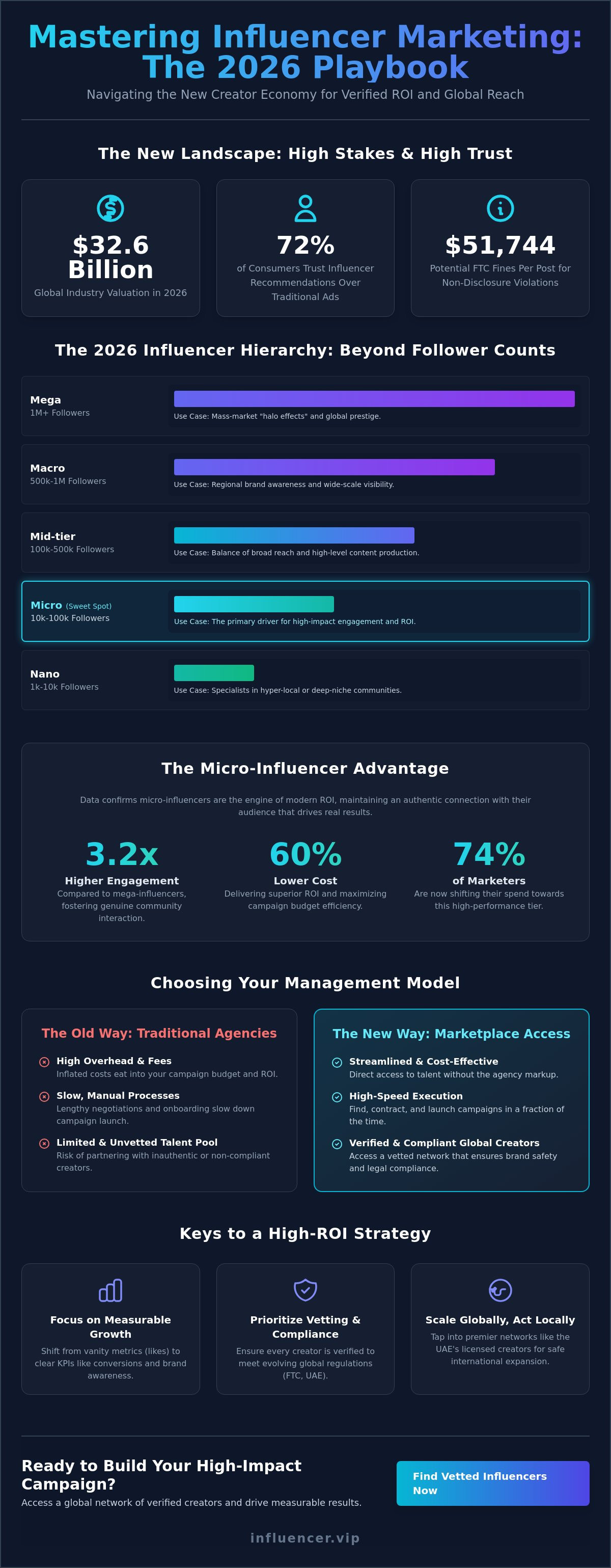
The 2026 Influencer Hierarchy: Moving Beyond Follower Counts
Building a High-ROI Strategy: From Brief to Cinematic Content
What is Influencer Marketing in 2026? Defining the New Creator Economy
In 2026, What is Influencer Marketing has matured into a disciplined, $32.6 billion sector. It's defined as a strategic partnership between brands and verified content creators to drive authentic engagement. We've moved past the era of generic celebrity endorsements. Today, the focus is on "community-driven influence," where creators serve as trusted advisors to specific, highly engaged niches. This shift reflects a fundamental change in how people discover and buy products in a digital-first world.
The scale of this shift is massive. According to data from Digital Applied (April 2026), 72% of consumers now trust influencer recommendations over traditional brand advertising. Creators have become the vital bridge between a brand’s promise and the consumer’s trust. They provide the social proof that traditional broadcast ads simply can't replicate. By sharing real-world experiences, these creators transform a corporate message into a relatable, human conversation.
To better understand the fundamentals of this industry and how it has evolved, watch this helpful video:
The Evolution of Social Influence
The landscape has shifted from chasing broad reach to securing niche authority. Brands now understand that smaller, focused audiences provide far better conversion rates than massive, diluted ones. This has led to the rise of the "Creator-Entrepreneur." These professionals don't just post photos; they manage businesses, hold mandatory licenses, and maintain rigorous content standards. In 2026, influencer marketing differs from traditional celebrity ads because it prioritizes peer-to-peer validation and ongoing dialogue over one-way, polished broadcasting.
Why Brands are Investing More in Influencers
Marketing teams are increasing their budgets because creator-led content successfully bypasses ad-blockers and the growing problem of "banner blindness." By using native storytelling, brands can appear in a user’s feed as a recommendation rather than an intrusion. There's also a significant cost advantage. Leveraging a verified influencer directory allows for high-quality content generation at a fraction of the cost of traditional studio production. Long-term partnerships are now the standard, as they build deeper brand equity and keep your message consistent across evolving social platforms.
The 2026 Influencer Hierarchy: Moving Beyond Follower Counts
Follower counts are no longer the primary measure of success. In 2026, the industry has moved toward a more sophisticated hierarchy that prioritizes quality assurance over sheer volume. While the traditional tiers still exist, the way brands utilize them has fundamentally changed. You can now browse verified influencers across all categories, ensuring your budget supports creators who actually deliver results.
The standard breakdown for influencer marketing tiers in 2026 includes:
Nano-influencers (1k–10k): Specialists in hyper-local or deep-niche communities.
Micro-influencers (10k–100k): The current "sweet spot" for most performance-driven campaigns.
Mid-tier influencers (100k–500k): A balance of broad reach and high-level content production.
Macro-influencers (500k–1M): Ideal for regional brand awareness and wide-scale visibility.
Mega-influencers (1M+): Used primarily for mass-market "halo effects" and global prestige.
Data from Digital Applied (April 2026) confirms that micro-influencers are the engine of modern ROI. They deliver 3.2 times higher engagement at a 60% lower cost compared to mega-influencers. This efficiency is why 74% of marketers are shifting their spend toward these mid-level creators who maintain an authentic connection with their audience.
Reach vs. Resonance: Choosing the Right Tier
Massive reach doesn't always equal massive impact. Mega-influencers are excellent for high-level awareness, but they often lack the "buy-in" seen in smaller tiers. Nano-influencers work best for high-intent conversion campaigns because their followers view them as peers rather than distant celebrities. A strategic allocation across multiple tiers usually outperforms a single-tier approach. By mixing broad awareness from macro-creators with the high-intent resonance of micro-creators, you create a full-funnel marketing effect.
The Importance of Vetting for Authenticity
The market is saturated with unvetted talent, making brand safety a top priority. Identifying "red flags" like bot engagement, fake followers, or inconsistent metrics is now a requirement for any serious campaign. Beyond numbers, you must ensure your partners follow the latest FTC disclosure guidelines to avoid heavy fines. The Influencer vetting process removes this burden by verifying every creator's professional standing and audience health before they join our directory. A "Verified" badge is more valuable than a high follower count because it guarantees professional accountability and audience authenticity. If you're ready to secure your next campaign with vetted talent, you can speak with our strategy team today.
Marketplace vs. Agency: Choosing Your Management Model
Deciding how to manage your creator partnerships determines your speed to market. For years, full-service agencies were the default choice for influencer marketing. However, the landscape has changed. In 2026, the traditional agency model is often too slow and expensive for agile brands. Agencies typically add layers of bureaucracy that delay campaign launches by weeks. By the time an agency manually vets a creator and negotiates a contract, the cultural moment has often passed. This friction makes it difficult to maintain a consistent presence in a fast-moving digital economy.
Marketplaces offer a decisive advantage in speed and transparency. Instead of waiting for an account manager to provide a curated list, you get direct creator access. You can view real-time data, previous campaign results, and verified engagement metrics instantly. This transparency builds trust. It ensures you're paying for actual influence rather than agency markups. For a deeper look at selecting the right tools for your region, check out The Best Influencer Marketing Platform in Dubai: 2026 Buyer’s Guide.
Cost efficiency is perhaps the most compelling reason to switch. Marketplaces eliminate heavy middle-man management fees that can consume up to 30% of your total budget. By using Campaign Management Tools, you reinvest those savings directly into higher-quality talent or broader reach. Understanding foundational concepts like What is Influencer Marketing helps clarify why direct, data-driven collaboration has become the 2026 industry standard for scaling your influencer marketing efforts.
Streamlining Campaign Workflows
Efficiency defines the marketplace experience. You can find the perfect niche fit in seconds using searchable databases. Centralized messaging replaces endless email threads; all communication stays within a single platform. You manage content approvals and payments in one dashboard. This organization reduces management overhead and lets your team focus on high-level strategy instead of administrative tasks.
Quality Assurance in a Global Marketplace
Managing global campaigns across the UAE, Canada, or Egypt is now possible from a single location. Verified directories play a massive role in reducing brand-safety risks. You don't have to worry about unvetted talent when the platform has already confirmed licenses and audience health. Direct collaboration also leads to more authentic content. When you speak directly to the creator, the brand brief doesn't get lost in translation through an agency mediator. This leads to content that feels genuine and resonates better with the creator's loyal community.
Building a High-ROI Strategy: From Brief to Cinematic Content
A high return on investment in 2026 is never an accident. It's the result of a disciplined workflow that treats influencer marketing as a high-end production engine rather than a simple social media post. Most brands fail because they focus on the "post" rather than the "process." To succeed, you need a strategy that bridges the gap between creative storytelling and hard performance data.
Building this strategy requires a four-step execution plan:
Step 1: Set Clear KPIs. Define your objective before contacting creators. Are you chasing top-of-funnel awareness, direct conversions measured by Customer Acquisition Cost (CAC), or high-quality content generation for your own channels?
Step 2: Craft the Strategic Brief. Create a document that provides enough structure to protect your brand identity while giving creators the freedom to speak to their audience authentically.
Step 3: Elevate Production Value. High-impact campaigns now require more than just smartphone footage. Integrating Cinematic Content Services ensures your brand is presented with professional-grade quality.
Step 4: Measure Real Success. Move beyond vanity metrics. Use tracking links, unique promo codes, and sentiment analysis to determine the true impact on your bottom line.
The Power of Cinematic Influencer Content
In a crowded feed, visual quality is your first line of defense against being ignored. This is why many top-tier brands now insist on cinematic drone videography to add a premium feel to their campaigns. This content does more than just look good; it builds "Content Equity." These are high-value assets your brand owns and can repurpose for paid social ads, web development, and email marketing. Instead of a one-time post that disappears, you gain a library of professional visuals that drive value for months.
Mastering the Strategic Brief
The best briefs follow the 70/30 rule: 70% creative freedom for the influencer and 30% strict brand guidelines. You must clearly define deliverables, deadlines, and usage rights. A "Do Not" list is equally vital to prevent brand-safety issues. Balancing these elements is the core of Mastering Influencer Campaign Management. When you empower a creator with the right tools and a clear vision, the resulting content feels like a natural recommendation rather than a forced advertisement. If you want to see how cinematic production can transform your next campaign, book a strategy session with our production team.
Scaling Globally with Influencer: The UAE Advantage
The UAE has solidified its position as the global center for the creator economy in 2026. With mandatory dual licensing now fully enforced since February 1, 2026, the region offers a level of professionalism and security that is unmatched in other markets. This regulatory framework ensures every creator is a legitimate business entity. It significantly lowers the legal risks for international brands and sets a high bar for content quality. For a deep dive into how this ecosystem operates, read Influencer Marketing in Dubai: The Ultimate Guide.
Influencer acts as the essential bridge in this professionalized landscape. We connect brands with top-tier, verified talent across the Middle East and beyond. Our platform is built for speed. You get direct access to a Verified Influencer Directory that has already passed rigorous quality assurance checks. This removes the traditional friction from influencer marketing. It allows you to scale your reach without the overhead of manual vetting or administrative delays.
Local Expertise, Global Reach
Navigating regional nuances is critical for international success. The "Made with love in the UAE" signature represents a commitment to high production standards and ambitious growth. Our local expertise helps brands build global trust by leveraging the authenticity of regional creators. Whether you're expanding into Egypt, Canada, or the GCC, our global network provides the specific niche authority you need. You can manage these diverse partnerships through our Campaign Management Tools to ensure your brand identity remains protected across every market.
Getting Started: Your First Campaign
We've eliminated the barriers to entry with our "Start Free" model. Ambitious brands can begin their journey without the burden of heavy upfront commitments. The process is designed to be efficient. Post your first campaign, define your cinematic requirements, and receive bids from verified creators who are ready to collaborate. This direct access ensures transparency and competitive pricing. You'll see proven results through our integrated performance tracking. Stop managing messy spreadsheets and start building high-impact partnerships. Amplify your brand with Influencer today and lead the 2026 creator economy.
Secure Your Competitive Edge in the Creator Economy
Success in 2026 requires a fundamental shift from chasing vanity metrics to securing verified partnerships. You've seen how the right hierarchy of creators, backed by cinematic production and a streamlined marketplace model, can transform your brand's reach into measurable growth. By prioritizing quality assurance and leveraging the UAE's professionalized landscape, you eliminate the common risks that often derail global campaigns. It's no longer about how many people see your content; it's about how many trust the person sharing it.
It's time to stop managing manual outreach and start scaling with a platform that guarantees authenticity. We provide the tools you need to master influencer marketing and achieve proven results; in fact, 92% of businesses found the right influencer on our platform. You now have direct access to verified global creators who are ready to amplify your message with high-end visuals and genuine community trust. Find and Hire Top Verified Influencers Now to start building your next high-impact campaign. Your brand's next level of growth is just one verified partnership away.
Frequently Asked Questions
Is influencer marketing still effective in 2026?
Yes, it remains a cornerstone of digital strategy with the industry valued at $32.6 billion in 2026. Data shows that 72% of consumers trust creator recommendations over traditional ads. This effectiveness stems from the shift toward authentic, community-driven content that bypasses traditional ad-blockers. Brands continue to increase budgets because influencers provide the human connection that corporate messaging often lacks.
How much does influencer marketing cost for a small business?
Costs vary based on the platform and follower tier. Nano-influencers on Instagram typically charge between $50 and $200 per post, while micro-influencers range from $200 to $1,500. Small businesses often find the highest ROI with micro-influencers, as they deliver 3.2 times higher engagement than mega-influencers. Starting with a smaller, focused group allows you to test content performance without a massive upfront investment.
What is the difference between a verified influencer and a regular creator?
Verified influencers have passed a rigorous Quality Assurance process to confirm their audience authenticity and professional standing. Regular creators are unvetted; this increases the risk of brand-safety issues or bot-driven engagement. Choosing verified talent ensures you're working with licensed professionals who have a proven track record of delivering real conversions. It's the difference between gambling your budget and investing in secure, high-quality results.
Can I use influencer marketing for a B2B business?
Absolutely, influencer marketing is one of the fastest-growing sectors for B2B. In 2026, B2B brands allocated $4.1 billion to these programs, marking a 47% year-over-year growth. Business leaders rely on niche authority figures for software and service recommendations. Partnering with industry experts allows B2B companies to build trust within specific professional communities far more effectively than through cold outreach or banner ads.
How do I track the ROI of my influencer campaign?
You should track ROI by moving away from vanity metrics like likes and focusing on performance-based data. Use unique tracking links, dedicated promo codes, and sentiment analysis to measure direct impact. Key metrics include Customer Acquisition Cost (CAC) and Average Order Value (AOV). By analyzing these figures, you can determine exactly how much revenue each creator partnership generates for your brand.
What happens if an influencer buys fake followers?
Working with influencers who use fake followers results in wasted budget and skewed data. You lose the opportunity for authentic engagement and risk damaging your brand reputation. This is why platform vetting is essential. Professional tools analyze engagement patterns to identify bots. If a creator fails these checks, they don't receive a verified status, protecting your campaign from ineffective spending.
How many influencers should I work with for my first campaign?
We recommend starting with a group of 3 to 5 micro-influencers for your first campaign. This sample size is large enough to provide diverse data points but small enough to manage efficiently. You can compare different content styles and audience reactions to see what resonates best. Once you identify the top performers, you can scale your budget and build long-term partnerships with those specific creators.
What are the legal requirements for influencer disclosures in the UAE?
As of February 1, 2026, all creators in the UAE must hold a Commercial Trade License and an Advertiser Permit. These regulations apply to both paid and unpaid promotional content. Brands share the responsibility of verifying that their partners hold these necessary permits. Failing to comply can lead to significant legal complications, making it vital to work through a platform that enforces these standards.
Comments
Leave a Comment
No comments yet. Be the first to share your thoughts!
Related Posts
How to Find the Right Influencers for Your Brand in the UAE in 2026
Finding influencers in the UAE is easy. Finding the right influencers is not. Learn how to select creators based on audience, location, niche, engagement, authenticity, and campaign goals.

Influencer Marketplace vs Agency: Choosing the Right Solution in 2026
74% of marketers plan to increase their influencer marketing budgets in 2026, yet many are still losing up to 30% of that spend to opaque fees. When deciding between an influencer marketplace vs agency, the stakes are high. You’re likely tired of the exhausting manual search for creators and the con…

Real Estate Drone Videography Dubai: 2026 Guide & Best Drones for Luxury Listings
In the 2026 Dubai property market, a high-resolution drone video is no longer a luxury; it's the bare minimum for entry. You likely recognize that standing out in oversaturated districts like Dubai Marina or Palm Jumeirah requires more than just standard listings. The complexity of navigating drone…